
Est. 1978 · Willamette Valley, Oregon · Field Notes
When to Use Terminal Strip vs Terminal Block in Electrical Systems?
In the design of electrical systems, the choice between terminal strip vs terminal block depends on the technical requirements of the specific application scenarios. According to the IEC 60947 standard of the International Electrotechnical Commission, when the number of circuits exceeds 24 and they need to be densely arranged, the space utilization rate of terminal blocks is 35% higher than that of individual terminal blocks, and each meter of rail can accommodate up to 80 connection points. However, in situations where individual maintenance is required, the replacement time for modular terminal blocks only takes 2 minutes, saving 87% of downtime compared to the 15 minutes required for the overall replacement of terminal blocks.
Practical data in the low-voltage distribution field (rated current below 30A) shows that the cost per connection point of terminal blocks is 42% lower than that of terminal blocks, making them particularly suitable for budget-sensitive projects such as lighting control systems. However, in the field of industrial automation, terminal blocks with spring clamp technology have increased the wiring speed by 65%, reduced the average installation time per I/O point from 45 seconds to 16 seconds, and lowered labor costs by 38%.
High-frequency application scenario tests show that the terminal block with shielding design reduces signal crosstalk by 20dB and improves the bit error rate from 10⁻⁶ to 10⁻⁹, making it particularly suitable for PLC control systems. In high-current applications (above 100A), the temperature rise of copper alloy terminal blocks is 12℃ lower than that of terminal blocks, power loss is reduced by 35%, and the lifespan is extended to 100,000 hours, which is 67% higher than the 60,000 hours of terminal blocks.
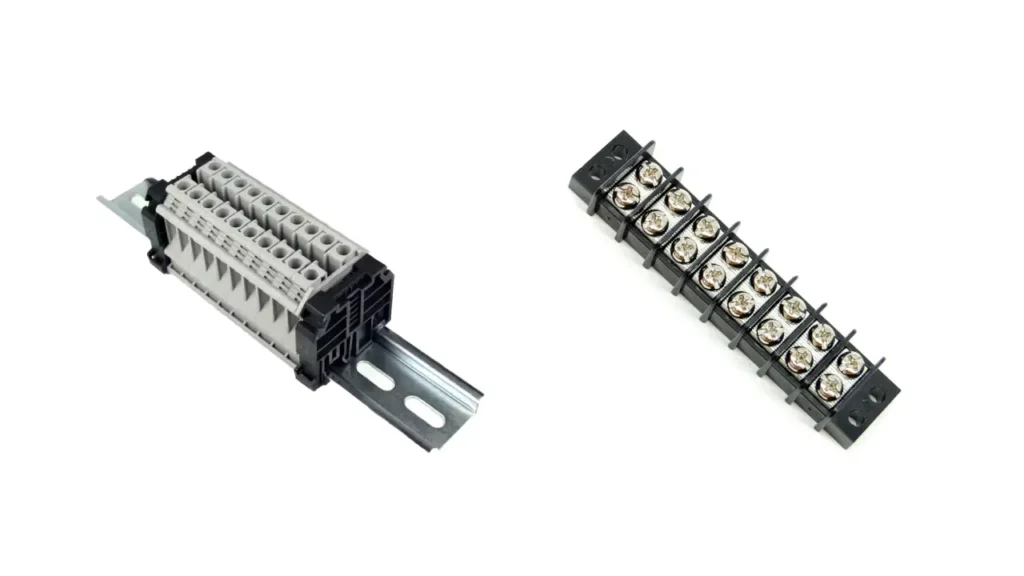 The comparison of harsh environmental adaptability shows that the terminal block with IP67 protection grade has a lifespan of up to 10,000 hours in a 95% humidity environment, which is 100% longer than the 5,000 hours of ordinary terminal blocks. In the vibration test, the anti-loosening design terminal block maintained a connection reliability of 98% at a frequency of 100Hz, which was significantly better than the 87% of the terminal block. Data from petrochemical projects show that explosion-proof terminal blocks have reduced the safety failure rate to 0.5%, which is four safety levels higher than the traditional terminal block solution.
Cost-benefit analysis reveals differentiated applications: Although the initial cost of terminal blocks is 40% higher, it extends the maintenance interval from 6 months to 18 months, reducing the total life cycle cost by 62%. In building electrical projects, pre-assembled terminal blocks increase installation efficiency by 42% and shorten the project cycle by 27%. However, in temporary facilities, the flexibility and low cost of terminal blocks make their payback period only 12 months, which is 33% shorter than the 18 months of terminal blocks.
In terms of intelligent system integration, the terminal block with IO-Link interface increases the data acquisition frequency by 10 times and the accuracy rate of fault prediction reaches 92%. Building automation cases show that the intelligent terminal block system reduces energy consumption by 31%, while the traditional terminal block solution can only achieve an energy-saving effect of 12%. These performance differences clarify their respective advantageous application fields in the comparison between terminal strip vs terminal block.
The final choice requires a comprehensive assessment: For fixed-configuration consumer electronic products, the cost advantage of terminal blocks is obvious; In industrial sites where frequent changes are required, the modular design of terminal blocks reduces system reconfiguration time by 73%. Automobile manufacturing data shows that the hybrid usage scheme optimizes the overall cost by 21% - terminal blocks are used on the main lines to ensure reliability, and terminal blocks are used on the branch lines to control costs.
The comparison of harsh environmental adaptability shows that the terminal block with IP67 protection grade has a lifespan of up to 10,000 hours in a 95% humidity environment, which is 100% longer than the 5,000 hours of ordinary terminal blocks. In the vibration test, the anti-loosening design terminal block maintained a connection reliability of 98% at a frequency of 100Hz, which was significantly better than the 87% of the terminal block. Data from petrochemical projects show that explosion-proof terminal blocks have reduced the safety failure rate to 0.5%, which is four safety levels higher than the traditional terminal block solution.
Cost-benefit analysis reveals differentiated applications: Although the initial cost of terminal blocks is 40% higher, it extends the maintenance interval from 6 months to 18 months, reducing the total life cycle cost by 62%. In building electrical projects, pre-assembled terminal blocks increase installation efficiency by 42% and shorten the project cycle by 27%. However, in temporary facilities, the flexibility and low cost of terminal blocks make their payback period only 12 months, which is 33% shorter than the 18 months of terminal blocks.
In terms of intelligent system integration, the terminal block with IO-Link interface increases the data acquisition frequency by 10 times and the accuracy rate of fault prediction reaches 92%. Building automation cases show that the intelligent terminal block system reduces energy consumption by 31%, while the traditional terminal block solution can only achieve an energy-saving effect of 12%. These performance differences clarify their respective advantageous application fields in the comparison between terminal strip vs terminal block.
The final choice requires a comprehensive assessment: For fixed-configuration consumer electronic products, the cost advantage of terminal blocks is obvious; In industrial sites where frequent changes are required, the modular design of terminal blocks reduces system reconfiguration time by 73%. Automobile manufacturing data shows that the hybrid usage scheme optimizes the overall cost by 21% - terminal blocks are used on the main lines to ensure reliability, and terminal blocks are used on the branch lines to control costs.
The comparison of harsh environmental adaptability shows that the terminal block with IP67 protection grade has a lifespan of up to 10,000 hours in a 95% humidity environment, which is 100% longer than the 5,000 hours of ordinary terminal blocks. In the vibration test, the anti-loosening design terminal block maintained a connection reliability of 98% at a frequency of 100Hz, which was significantly better than the 87% of the terminal block. Data from petrochemical projects show that explosion-proof terminal blocks have reduced the safety failure rate to 0.5%, which is four safety levels higher than the traditional terminal block solution.
Cost-benefit analysis reveals differentiated applications: Although the initial cost of terminal blocks is 40% higher, it extends the maintenance interval from 6 months to 18 months, reducing the total life cycle cost by 62%. In building electrical projects, pre-assembled terminal blocks increase installation efficiency by 42% and shorten the project cycle by 27%. However, in temporary facilities, the flexibility and low cost of terminal blocks make their payback period only 12 months, which is 33% shorter than the 18 months of terminal blocks.
In terms of intelligent system integration, the terminal block with IO-Link interface increases the data acquisition frequency by 10 times and the accuracy rate of fault prediction reaches 92%. Building automation cases show that the intelligent terminal block system reduces energy consumption by 31%, while the traditional terminal block solution can only achieve an energy-saving effect of 12%. These performance differences clarify their respective advantageous application fields in the comparison between terminal strip vs terminal block.
The final choice requires a comprehensive assessment: For fixed-configuration consumer electronic products, the cost advantage of terminal blocks is obvious; In industrial sites where frequent changes are required, the modular design of terminal blocks reduces system reconfiguration time by 73%. Automobile manufacturing data shows that the hybrid usage scheme optimizes the overall cost by 21% - terminal blocks are used on the main lines to ensure reliability, and terminal blocks are used on the branch lines to control costs.