
Fragrance Buying for the EU: How Supplier Audits Have Changed
The rules a fragrance supplier has to satisfy have moved more in the past few years than in the previous decade: EU allergen labelling has expanded, the IFRA Standards have been updated again, and the EU's packaging rules are tightening around recyclability. For a buyer the practical effect is that capability audits now have to test things that used to be assumed, current allergen data, up-to-date IFRA screening and packaging documentation. A factory that answers these questions from a documented habit rather than from memory is worth more than one that answers confidently off the top of its head.
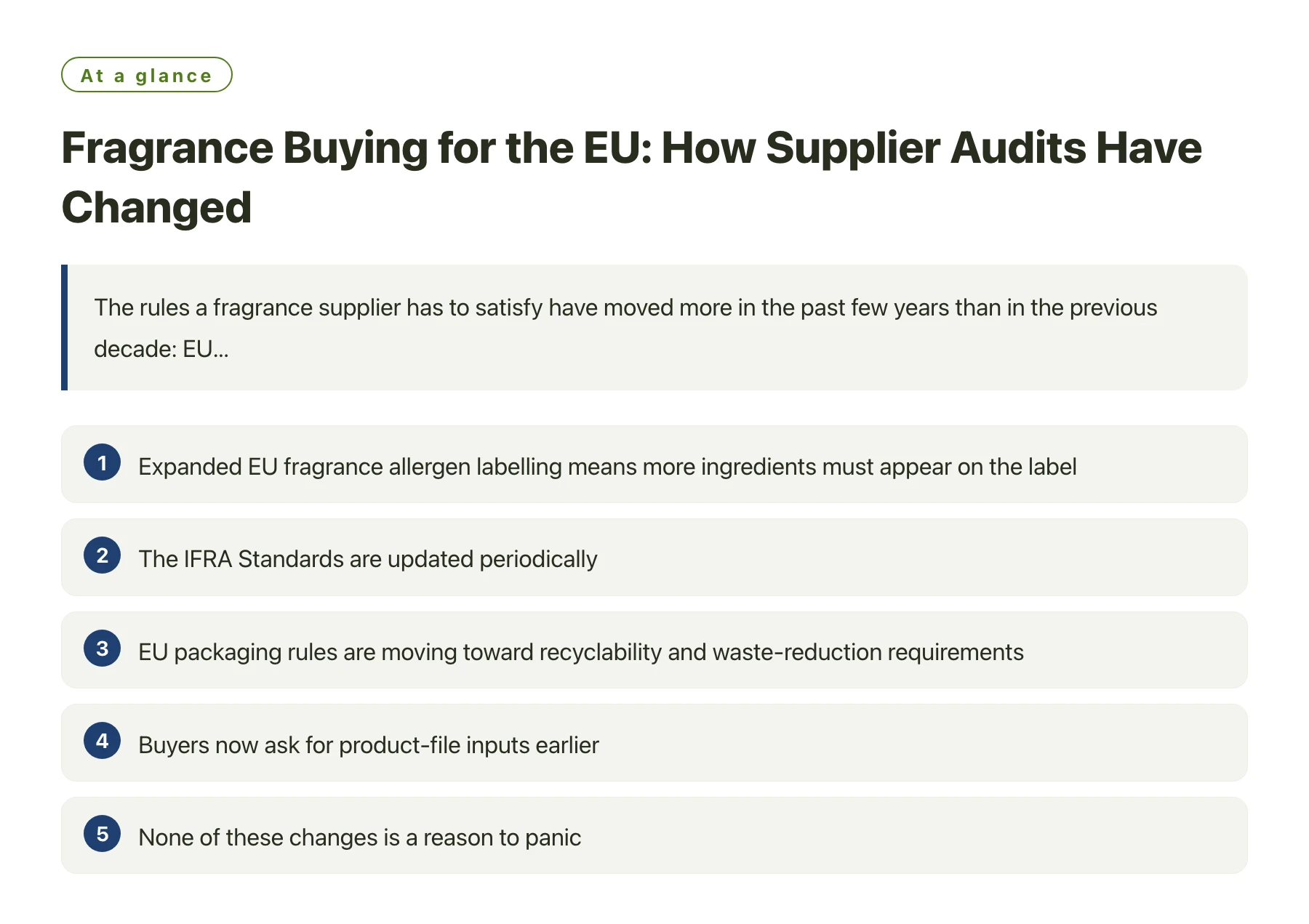
Key takeaways
- Expanded EU fragrance allergen labelling means more ingredients must appear on the label, and the declaration has to come from the current formula version.
- The IFRA Standards are updated periodically, so 'IFRA compliant' only means something with a version and a date attached.
- EU packaging rules are moving toward recyclability and waste-reduction requirements, which makes packaging documentation part of the supplier audit.
- Buyers now ask for product-file inputs earlier, which rewards factories with standardised document packs.
- None of these changes is a reason to panic; all of them are reasons to check the dates on documents.
When the rules move, the burden lands unevenly. For a factory that exports to the EU regularly, updates are routine maintenance; for a factory selling opportunistically, each change arrives as a scramble. The audit question is which kind you are standing in front of.
This article walks through the changes that matter for an EU launch, what they mean for your product, and how to test a supplier against them.
Where the rules have moved
Three fronts have changed in a short window, and each one touches a different part of the product: the label, the formula and the packaging.
On the label: the EU has extended the list of fragrance allergens that must be named on cosmetic labels through amendments to the cosmetics regulation, with the labelling obligations phasing in for different product sizes. The European Commission's cosmetics pages track the allergen requirements and the current list [1]. For a buyer the consequence is simple: the allergen declaration must come from the exact formula version being produced, because the label cannot be reused when the list grows.
On the formula: the IFRA Standards, which set use limits for fragrance ingredients, have been updated in a new amendment to the Code of Practice with revised limits for a number of materials [2]. Compliance statements written against older amendments are not evidence of current compliance; the statement needs a version and a date.
On the packaging: the EU's packaging waste framework is being tightened, with recyclability and waste-reduction requirements taking effect in stages for all packaging placed on the market [3]. A beautiful but hard-to-recycle combination of materials is becoming a liability rather than a feature.
Recent changes and what they demand from a supplier
| What changed | What it means for your product | What the audit should check |
|---|---|---|
| Expanded allergen labelling | More fragrance ingredients may appear on the label | An accurate allergen declaration tied to the current formula |
| IFRA amendment with new limits | Some ingredients now have tighter maximum use levels | Formulas screened against the current standards, with dates |
| Tighter EU packaging rules | Recyclability and waste reduction matter at launch | Packaging materials and markings documented, not assumed |
| Earlier product-file requests | Buyers need inputs sooner in the timeline | A standardised document pack ready on request |
Notice the pattern: every change moves in the same direction, from assumed to documented. The audit is simply the check that the documentation exists.
Testing a supplier against the new rules
Three quick tests cover most of it. First, ask for the dates: when was the last IFRA statement generated and against which amendment? Second, ask for a recent EU-bound product's label and its allergen declaration side by side; the pair should match. Third, ask who in the factory owns packaging compliance; a named owner suggests a process, a blank stare suggests an event.
The same pressure applies to the people side of the business. As compliance deepens, so does the value of training: perfumers and account managers need current knowledge to answer the questions above without checking with three departments. A manufacturer that maintains its own perfumery education programme, Xuelei, for example, runs a fragrance academy in cooperation with ISIPCA, treats that knowledge as infrastructure rather than as an expense.
For a buyer, the most efficient information source is the factory's own published material, because it shows whether documentation is treated as infrastructure. the factory behind these scents publishes its certifications, service scope and training programmes outright, the sort of transparency that makes an EU audit shorter, because half the questions are already answered in public.
Under a private label model the questions above still apply, because the brand carries the label risk: private label fragrance production shifts the documentation work downstream to you, so the audit has to confirm the factory can produce the inputs your responsible person will need.
For your own team, closing the knowledge gap matters too: professional scent training at the factory level is what turns internal answers into answers the buyer can act on, and it is a fair question to ask which staff have taken it.
Sources
- European Commission: Cosmetic Products — Specific Topics —— EU pages covering specific cosmetics topics such as product claims, nanomaterials and animal-testing rules.
- IFRA Standards Library (International Fragrance Association) —— The IFRA Standards Library lists the restrictions the fragrance industry applies to individual fragrance ingredients, based on safety assessments; it is the reference point for compliant fragrance formulation.
- European Commission: Packaging Waste and the PPWR —— EU rules on packaging and packaging waste, including the Packaging and Packaging Waste Regulation requirements on recyclability and design.
Frequently asked questions
Do the new EU allergen rules affect products already on the market?
Labelling obligations phase in over time depending on product size and existing stock, but a reformulated product starts under the new rules immediately. Check the amending act's transition schedule on the Commission's cosmetics pages.
Does 'IFRA compliant' still mean anything if the standards keep changing?
Yes, if the statement names the version and the date. The phrase without either is a marketing sentence, not a document.
Will my perfume need different packaging for the EU?
Possibly. The tightening EU packaging rules push toward recyclable materials and clearer markings, so confirm your bottle, cap and carton choices against the current requirements before tooling.
How do I verify a supplier keeps up with rule changes?
Ask for document dates, a recent EU-bound label paired with its allergen declaration, and the name of the person who owns packaging compliance. Consistency across those three is a good signal.
Do these changes raise production costs?
They shift costs: documentation becomes a routine line instead of an emergency, and compliant packaging may cost more than the cheapest alternative. Budgeting for documentation as a normal line item is the honest fix.