
Est. 1978 · Willamette Valley, Oregon · Field Notes
How to choose the best duplex milling machine for your workshop?
When choosing the best double-sided milling machine for your workshop, the first step is to precisely assess the match between the processing requirements and the equipment performance matrix. The price range of a standard duplex milling machine tool is from 800,000 to 2 million yuan, and its return on investment is highly dependent on the batch size of workpieces. For instance, for medium-sized batch production, if the daily output needs to be increased from 100 pieces to 150 pieces, then the worktable size should be at least 1600mm×800mm, and the spindle power should be above 22kW. According to the research data of the Machinery Industry Association in 2023, users whose demands are precisely matched can recover their investment within 18 months, while incorrect selection will result in equipment utilization rates below 40%, with an average annual loss of over 300,000 yuan. You should ensure that the equipment specifications match the production rhythm perfectly, just as you choose gears for a precision watch.
Core accuracy parameters are the lifeline of decision-making, and it is necessary to examine the comprehensive performance of static accuracy and dynamic accuracy. An excellent double-sided milling machine should have a positioning accuracy of ±0.005mm, a repeat positioning accuracy of ±0.003mm, and the synchronization error between the two spindle heads should be less than 0.01mm. Take the processing of engine connecting rods as an example. If the parallelism requirement is 0.02mm, then the geometric accuracy tolerance of the machine tool must be controlled within one-third of the required value, that is, 0.006mm. A study of five leading enterprises shows that workshops that strictly follow this proportion in product selection have reduced their product defect rate by 2.5 percentage points and saved over 500,000 yuan in quality costs annually. This requires you to examine the authenticity of the data behind each calibration certificate like a rigorous metrologist.
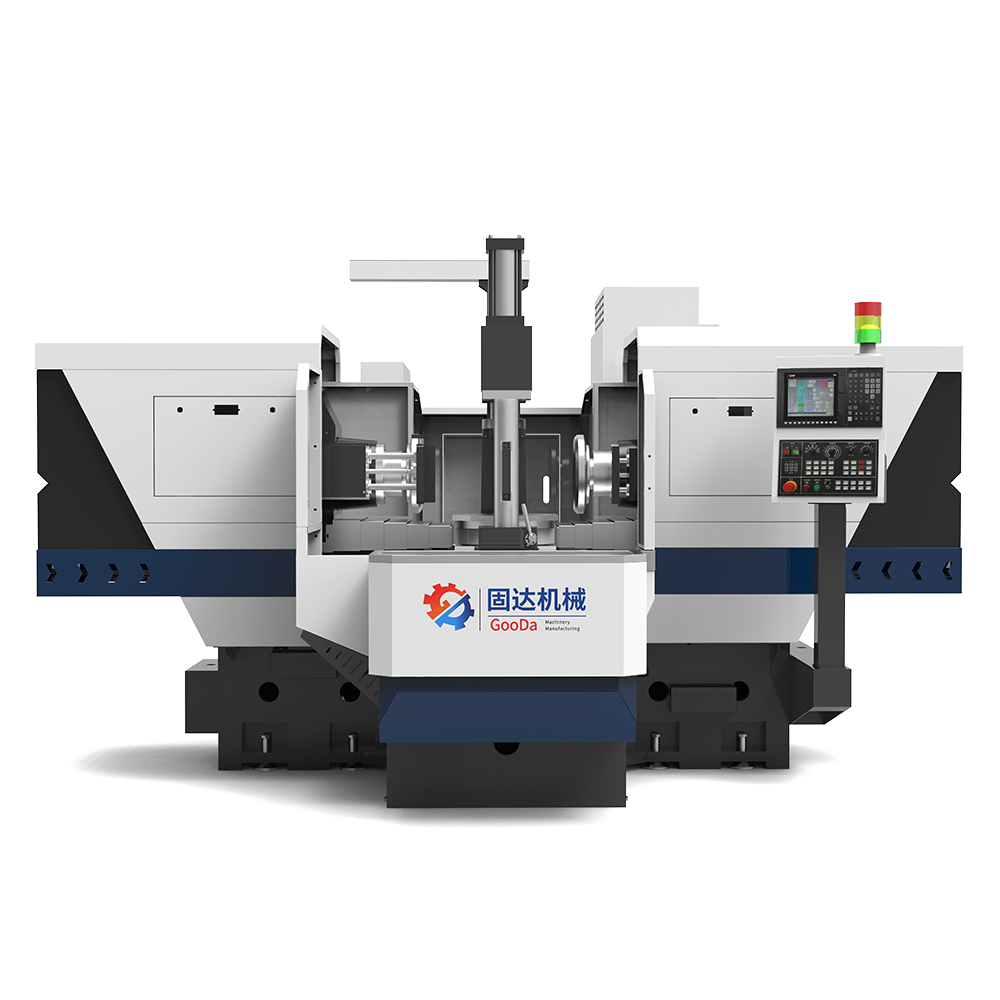 The mechanical structure and control system form the cornerstone of the long-term stability of the equipment. The bed should be made of high-strength closely baked cast iron. The load capacity of the guide rails should exceed 3000kg, and the thermal deformation compensation system should be able to suppress the accuracy deviation caused by temperature fluctuations within ±0.001mm/°C. When choosing a numerical control system, such as Siemens 840D sl or Fanuc 31i series, the data block processing speed should be less than 1 millisecond to ensure that the program segment transition accuracy of 0.1mm can still be maintained at a feed rate of 15m/min. There are cases showing that a mold factory, by choosing a model with real-time vibration suppression function, has extended the tool life by 20%, which is equivalent to reducing the annual budget for cutting tools by 80,000 yuan.
The final decision-making balance should tilt towards the full life cycle cost and technical services, rather than just the procurement budget. The design life of a high-quality double-sided milling machine is usually 10 years, but the maintenance cost within 10 years may be as high as 60% of the initial price of the equipment. Therefore, it is necessary to focus on examining the supplier's response time (such as a commitment to provide remote support within 4 hours), spare parts inventory rate (with a target of over 95%), and refer to other user data: brands with good service can reduce the average annual downtime to within 100 hours, indirectly ensuring a 98% on-time order delivery rate. Your choice will be like injecting a strong heart into the workshop, and as a result, the fluctuation range of production efficiency over the next five years can be stabilized within the ideal range of ±5%.
The mechanical structure and control system form the cornerstone of the long-term stability of the equipment. The bed should be made of high-strength closely baked cast iron. The load capacity of the guide rails should exceed 3000kg, and the thermal deformation compensation system should be able to suppress the accuracy deviation caused by temperature fluctuations within ±0.001mm/°C. When choosing a numerical control system, such as Siemens 840D sl or Fanuc 31i series, the data block processing speed should be less than 1 millisecond to ensure that the program segment transition accuracy of 0.1mm can still be maintained at a feed rate of 15m/min. There are cases showing that a mold factory, by choosing a model with real-time vibration suppression function, has extended the tool life by 20%, which is equivalent to reducing the annual budget for cutting tools by 80,000 yuan.
The final decision-making balance should tilt towards the full life cycle cost and technical services, rather than just the procurement budget. The design life of a high-quality double-sided milling machine is usually 10 years, but the maintenance cost within 10 years may be as high as 60% of the initial price of the equipment. Therefore, it is necessary to focus on examining the supplier's response time (such as a commitment to provide remote support within 4 hours), spare parts inventory rate (with a target of over 95%), and refer to other user data: brands with good service can reduce the average annual downtime to within 100 hours, indirectly ensuring a 98% on-time order delivery rate. Your choice will be like injecting a strong heart into the workshop, and as a result, the fluctuation range of production efficiency over the next five years can be stabilized within the ideal range of ±5%.
The mechanical structure and control system form the cornerstone of the long-term stability of the equipment. The bed should be made of high-strength closely baked cast iron. The load capacity of the guide rails should exceed 3000kg, and the thermal deformation compensation system should be able to suppress the accuracy deviation caused by temperature fluctuations within ±0.001mm/°C. When choosing a numerical control system, such as Siemens 840D sl or Fanuc 31i series, the data block processing speed should be less than 1 millisecond to ensure that the program segment transition accuracy of 0.1mm can still be maintained at a feed rate of 15m/min. There are cases showing that a mold factory, by choosing a model with real-time vibration suppression function, has extended the tool life by 20%, which is equivalent to reducing the annual budget for cutting tools by 80,000 yuan.
The final decision-making balance should tilt towards the full life cycle cost and technical services, rather than just the procurement budget. The design life of a high-quality double-sided milling machine is usually 10 years, but the maintenance cost within 10 years may be as high as 60% of the initial price of the equipment. Therefore, it is necessary to focus on examining the supplier's response time (such as a commitment to provide remote support within 4 hours), spare parts inventory rate (with a target of over 95%), and refer to other user data: brands with good service can reduce the average annual downtime to within 100 hours, indirectly ensuring a 98% on-time order delivery rate. Your choice will be like injecting a strong heart into the workshop, and as a result, the fluctuation range of production efficiency over the next five years can be stabilized within the ideal range of ±5%.