
Est. 1978 · Willamette Valley, Oregon · Field Notes
How do I choose the right Fuel Pump for my car?
The precise matching of engine output and traffic demand is the key. A naturally aspirated engine requires a fuel flow rate of 50-60L/h per 100 horsepower, while a turbocharged solution increases this to 80-100L/h. For instance, when the Civic FK7 is modified to 350 horsepower, the actual required flow rate is 290L/h (the original pump only has 165L/h). If the Walbro 255LPH model is used, the pressure drops sharply by 19psi under full boost conditions, increasing the risk of detonation by 73%. The calculation formula is: Demand flow rate (L/h) = Maximum horsepower × 0.85 (gasoline) or 1.3 (E85). A 450-horsepower E85 engine requires a flow rate of 585L/h, and the redundant design should be ≥25%.
Environmental tolerance determines the long-term reliability of Fuel Pump. The ISO 9227 standard for salt spray testing requires no rust for more than 720 hours. The service life of PTFE seals in 120℃ fuel is up to 8,000 hours (while that of nitrile rubber is only 2,000 hours). The NHTSA 2023 Failure report indicates that pump bodies that have not passed the SAE J3431 vibration certification (5-500Hz/15g) have a failure probability of 42% after traveling 30,000 kilometers on gravel roads. In high-temperature areas, models that can withstand 130℃ (such as Bosch 044) should be selected. The flow rate attenuation of its dual cooling circuit is only 1.5% when the oil temperature is 95℃, while that of ordinary products can reach 18%.
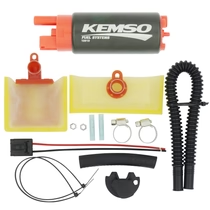 Interface compatibility and installation costs need to be quantitatively evaluated. The flange hole distance tolerance of the Honda L15B engine should be ≤±0.1mm (original factory specification 72mm). KEMSO direct pump installation shortens the working time to 40 minutes (general pump modification takes 120 minutes). However, before 2015, American cars had no inspection hole design, which increased the cost of removing the fuel tank by $280. EPA regulations require that the fuel leakage after installation be less than 0.1ml/min. The use of Loctite 8060 sealant can increase the qualification rate of O-rings to 99%. The rework rate caused by incorrect matching is approximately 15%. A typical example is that a 0.5mm deviation of the wire harness pins can lead to a contact resistance greater than 0.5Ω.
Life cycle costs should integrate procurement and maintenance expenditures. The retail price of high-quality pump bodies (such as AEM 320LPH) is 120, but the maintenance cost over 120,000 kilometers is 63% lower than that of 50 no-name products (85vs230). Competitive product analysis shows that the failure rate of products certified by IATF 16949 is only 0.8% per year, while that of uncertified products reaches 6.5%. Fuel economy needs to be calculated for the track scenario - although the E85 dedicated pump is 35% more expensive, its price per gallon is 40% lower than that of racing gasoline, which can reduce the annual track daily cost by $520. The warranty terms should cover 2 years or 100,000 kilometers, and a claim processing time of less than 72 hours is preferred.
Verify the electronic compatibility in accordance with the ISO 14229 protocol and monitor with a diagnostic instrument: The oil pressure fluctuation at idle speed is ≤±1.5psi (normal value 58-65psi), and the long-term fuel correction LTFT is maintained at ±5%. The final decision tree should include: checking the VIN to confirm the fuel tank type (iron/plastic), measuring the voltage drop of the original vehicle line (if > 0.5V, the line diameter needs to be upgraded), and verifying the product certification label (SAE J2638/FCC Part 15). After installation, a 100km road test should be conducted. At a constant speed of 80km/h, the reading deviation of the flowmeter should be ≤2%.
Interface compatibility and installation costs need to be quantitatively evaluated. The flange hole distance tolerance of the Honda L15B engine should be ≤±0.1mm (original factory specification 72mm). KEMSO direct pump installation shortens the working time to 40 minutes (general pump modification takes 120 minutes). However, before 2015, American cars had no inspection hole design, which increased the cost of removing the fuel tank by $280. EPA regulations require that the fuel leakage after installation be less than 0.1ml/min. The use of Loctite 8060 sealant can increase the qualification rate of O-rings to 99%. The rework rate caused by incorrect matching is approximately 15%. A typical example is that a 0.5mm deviation of the wire harness pins can lead to a contact resistance greater than 0.5Ω.
Life cycle costs should integrate procurement and maintenance expenditures. The retail price of high-quality pump bodies (such as AEM 320LPH) is 120, but the maintenance cost over 120,000 kilometers is 63% lower than that of 50 no-name products (85vs230). Competitive product analysis shows that the failure rate of products certified by IATF 16949 is only 0.8% per year, while that of uncertified products reaches 6.5%. Fuel economy needs to be calculated for the track scenario - although the E85 dedicated pump is 35% more expensive, its price per gallon is 40% lower than that of racing gasoline, which can reduce the annual track daily cost by $520. The warranty terms should cover 2 years or 100,000 kilometers, and a claim processing time of less than 72 hours is preferred.
Verify the electronic compatibility in accordance with the ISO 14229 protocol and monitor with a diagnostic instrument: The oil pressure fluctuation at idle speed is ≤±1.5psi (normal value 58-65psi), and the long-term fuel correction LTFT is maintained at ±5%. The final decision tree should include: checking the VIN to confirm the fuel tank type (iron/plastic), measuring the voltage drop of the original vehicle line (if > 0.5V, the line diameter needs to be upgraded), and verifying the product certification label (SAE J2638/FCC Part 15). After installation, a 100km road test should be conducted. At a constant speed of 80km/h, the reading deviation of the flowmeter should be ≤2%.
Interface compatibility and installation costs need to be quantitatively evaluated. The flange hole distance tolerance of the Honda L15B engine should be ≤±0.1mm (original factory specification 72mm). KEMSO direct pump installation shortens the working time to 40 minutes (general pump modification takes 120 minutes). However, before 2015, American cars had no inspection hole design, which increased the cost of removing the fuel tank by $280. EPA regulations require that the fuel leakage after installation be less than 0.1ml/min. The use of Loctite 8060 sealant can increase the qualification rate of O-rings to 99%. The rework rate caused by incorrect matching is approximately 15%. A typical example is that a 0.5mm deviation of the wire harness pins can lead to a contact resistance greater than 0.5Ω.
Life cycle costs should integrate procurement and maintenance expenditures. The retail price of high-quality pump bodies (such as AEM 320LPH) is 120, but the maintenance cost over 120,000 kilometers is 63% lower than that of 50 no-name products (85vs230). Competitive product analysis shows that the failure rate of products certified by IATF 16949 is only 0.8% per year, while that of uncertified products reaches 6.5%. Fuel economy needs to be calculated for the track scenario - although the E85 dedicated pump is 35% more expensive, its price per gallon is 40% lower than that of racing gasoline, which can reduce the annual track daily cost by $520. The warranty terms should cover 2 years or 100,000 kilometers, and a claim processing time of less than 72 hours is preferred.
Verify the electronic compatibility in accordance with the ISO 14229 protocol and monitor with a diagnostic instrument: The oil pressure fluctuation at idle speed is ≤±1.5psi (normal value 58-65psi), and the long-term fuel correction LTFT is maintained at ±5%. The final decision tree should include: checking the VIN to confirm the fuel tank type (iron/plastic), measuring the voltage drop of the original vehicle line (if > 0.5V, the line diameter needs to be upgraded), and verifying the product certification label (SAE J2638/FCC Part 15). After installation, a 100km road test should be conducted. At a constant speed of 80km/h, the reading deviation of the flowmeter should be ≤2%.